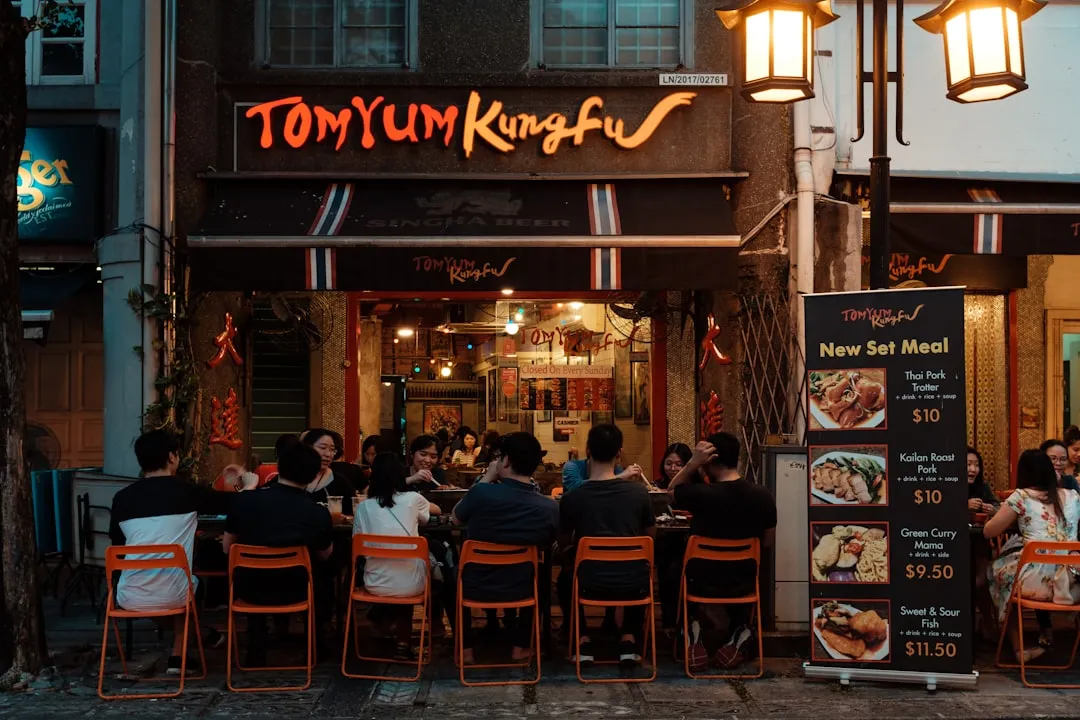
The way Singapore diners choose where to eat has shifted. Five years ago, the path was predictable: Google search, scroll through results, check a few review sites, make a booking. Today, a growing number of diners skip all of that and ask an AI directly.
“Best laksa near Joo Chiat.” “Quiet Italian restaurant for a date night in Tanjong Pagar.” “Halal restaurant with private dining room Singapore.”
These prompts are happening millions of times a month across ChatGPT, Gemini, and Perplexity. And the restaurants that get recommended aren’t necessarily the ones with the biggest marketing budgets — they’re the ones whose digital presence is structured in a way AI can understand and trust.
This is mainstream behaviour now, not an early-adopter edge case: Singapore sits among the world’s highest AI-adoption markets, and Google’s AI Overviews now appear on roughly half of all searches. “Ask the AI where to eat” is simply how a large share of diners decide in 2026.
How Singapore Diners Use AI to Find Restaurants
AI restaurant searches tend to be more specific and intent-driven than traditional Google searches. Instead of typing “Thai restaurant Singapore” and browsing a list, diners ask AI questions the way they’d ask a knowledgeable friend:
- “What’s the best Thai restaurant in Tiong Bahru for a group of 8?”
- “Family-friendly brunch spots in the East with outdoor seating”
- “Where can I get good wagyu omakase under $150 per person in Singapore?”
- “Halal restaurant near Bugis with private room for 20 people”
- “Best new restaurants that opened in Singapore in 2026”
Notice the pattern. These queries include cuisine type, location, budget, group size, dietary requirements, and specific features. AI models try to match all of these criteria simultaneously — which means your restaurant needs structured, detailed information available for AI to reference.
The AI Platforms That Matter for Restaurants
Not all AI platforms pull from the same sources, so understanding the differences matters.
ChatGPT draws from its training data, web browsing results, and — increasingly — partnerships with review platforms. When ChatGPT recommends restaurants, it frequently references Google Reviews, TripAdvisor, and well-known food blogs. In Singapore, it also pulls from Burpple and HungryGoWhere content that’s been indexed on the web.
Google Gemini and AI Overviews have direct access to Google’s own data: Google Maps, Google Business Profiles, and Google Reviews. If your Google Business Profile is incomplete or outdated, Gemini will deprioritise you. AI Overviews also pull from top-ranking webpages, making traditional SEO still relevant.
Perplexity explicitly cites its sources, making it easier to trace where recommendations come from. It indexes a wide range of web content, including food blogs, news articles, and directory listings.
Microsoft Copilot uses Bing’s index and tends to favour TripAdvisor and Yelp data, though its Singapore-specific coverage is thinner than the others.
What Makes AI Recommend One Restaurant Over Another?
AI models aren’t making subjective taste judgements. They’re matching data signals. Here’s what actually influences which restaurants get recommended:
Structured menu data. AI needs to know what you serve, not just that you’re a “restaurant.” A site that lists individual dishes with descriptions, prices, and dietary tags gives AI far more to work with than a PDF menu or an image-only menu page.
Cuisine type and specificity. Being clearly categorised matters. If your Google Business Profile says “Restaurant” but not “Peranakan Restaurant,” you’ll miss queries for “best Peranakan food in Singapore.” Be specific in every platform where you list your cuisine type.
Location signals. AI models are geographically aware. Your address, neighbourhood, and proximity to landmarks all influence recommendations. Make sure your address is consistent across your website, Google Business Profile, and all directory listings.
Review volume and sentiment. This is one of the strongest signals. A restaurant with 400 Google reviews averaging 4.3 stars will almost always outrank one with 30 reviews averaging 4.7 stars. Volume creates statistical confidence for AI. Sentiment (the actual words in reviews) matters too — AI can read and summarise what diners say about your food, service, and atmosphere.
Google Business Profile completeness. Restaurants with complete profiles — including menu, photos, hours, attributes (outdoor seating, reservations, delivery), and regular posts — get recommended more frequently than those with bare-minimum profiles.
Third-party platform presence. In Singapore specifically, your presence on Burpple, HungryGoWhere, Google Maps, TripAdvisor, and food blogs creates the third-party validation that AI models look for when deciding which restaurants to trust.
Singapore-Specific Platforms AI References
These are the local platforms that ChatGPT, Gemini, and Perplexity actively draw from when answering restaurant queries about Singapore:
Burpple — Singapore’s most active food discovery platform. Burpple reviews are well-indexed and frequently cited by AI. Having a claimed profile with updated menu, photos, and 20+ reviews makes a meaningful difference.
HungryGoWhere — though it’s had ownership changes over the years, HungryGoWhere content still appears in AI-generated restaurant recommendations, particularly for well-established restaurants with historical listings.
Google Maps Reviews — the single most important review platform for AI visibility. Google’s own AI products (Gemini, AI Overviews) weight Google Reviews heavily, and other AI platforms reference them too.
TripAdvisor — still relevant, especially for restaurants in tourist-heavy areas like Marina Bay, Chinatown, and Sentosa. ChatGPT references TripAdvisor data frequently for Singapore restaurant queries.
Food blogs and media — articles from Seth Lui, Miss Tam Chiak, Daniel Food Diary, and similar Singapore food bloggers get indexed and referenced by AI. A positive review from a well-known food blogger can directly influence AI recommendations.
The Straits Times and CNA Lifestyle — restaurant reviews and “best of” lists from major Singapore media outlets carry significant weight with AI models.
5 Steps to Get Your Restaurant Recommended by AI
1. Implement Restaurant Schema Markup
Add structured data to your website using the FoodEstablishment, Menu, and AggregateRating schemas. This gives AI platforms machine-readable information about your restaurant.
At minimum, your schema should include:
- Restaurant name, address, phone number, and opening hours
- Cuisine type (be specific: “Peranakan,” not just “Asian”)
- Menu items with prices in SGD
- Aggregate rating from Google Reviews
- Price range indicator
- Accepted payment methods
- Reservation links
If you don’t have a developer on hand, most modern website platforms have schema plugins. The investment is worth it — structured data is one of the clearest signals you can send to AI platforms.
2. Complete and Regularly Update Your Google Business Profile
Treat your Google Business Profile as your most important digital asset. This means:
- Full menu uploaded with current prices (update whenever prices change)
- High-quality photos — at least 20, including food shots, interior, exterior, and any private dining spaces
- All attributes checked — outdoor seating, delivery, takeaway, reservations, parking, wheelchair accessibility, halal certification
- Regular posts — share weekly updates, seasonal specials, or events
- Respond to every review — both positive and negative. AI tracks engagement patterns.
A Google Business Profile updated in the last 30 days signals freshness to AI. One last updated six months ago signals neglect.
3. Build Your Review Presence Across Multiple Platforms
Aim for at least 50 Google Reviews as a baseline. Beyond that, build presence on Burpple (claim your listing, encourage reviews) and TripAdvisor (especially if you serve tourists or are in a tourist-adjacent area).
How to encourage reviews without being pushy:
- Include a QR code linking to your Google Review page on the bill presenter
- Train staff to mention reviews naturally: “If you enjoyed your meal, we’d love a Google review”
- Respond to every review within 48 hours — this encourages others to leave feedback
- Share particularly good reviews on your social media (with the reviewer’s permission)
Don’t buy fake reviews. AI models are increasingly able to detect review manipulation, and platforms penalise it. Fifty genuine reviews are worth more than 200 fake ones.
4. Create Cuisine-Specific, Location-Specific Website Content
Your website should have pages that match the way people ask AI for recommendations. This means:
- A dedicated page for your cuisine type (“Authentic Peranakan Dining in Katong”)
- Location-specific content mentioning your neighbourhood and nearby landmarks
- Pages for special features: private dining, group bookings, halal certification, vegetarian options
- A blog or news section with updates about seasonal menus, events, or awards
Each page should include clear, factual statements that AI can quote. “Our private dining room seats up to 16 guests and can be booked for a minimum spend of $800” is far more useful to AI than “We offer intimate private dining experiences.”
5. Set Up llms.txt With Menu Highlights and Key Differentiators
The llms.txt file is a relatively new standard that tells AI crawlers what’s most important about your business. Place it at the root of your website (yourrestaurant.com/llms.txt) and include:
- Your restaurant name, cuisine type, and neighbourhood
- Your 5-10 signature dishes with brief descriptions
- Key differentiators (e.g., “Only restaurant in Singapore serving traditional Nyonya recipes from a 1920s family cookbook”)
- Awards or media mentions
- Practical details: price range, booking info, dietary accommodations
Think of llms.txt as a concise pitch to AI platforms. Keep it factual, specific, and under 500 words.
Real Prompts to Test Your AI Visibility
Run these prompts through ChatGPT, Gemini, and Perplexity and see whether your restaurant appears. If it doesn’t, you know where to focus:
- “Best [your cuisine] restaurant in [your neighbourhood] Singapore”
- “Where should I eat in [your area] tonight?”
- “[Your cuisine] restaurant Singapore for groups”
- “Restaurants near [nearby landmark] Singapore”
- “Best [your signature dish] in Singapore”
- “Halal [your cuisine] restaurant Singapore” (if applicable)
- “Affordable/fine dining [your cuisine] Singapore” (match your price point)
- “New restaurants in Singapore 2026”
- “Restaurant with private dining room [your area] Singapore”
- “Best restaurants for [specific occasion: birthday, anniversary, business lunch] in Singapore”
Document which platforms recommend you and which don’t. This gives you a clear baseline to measure progress against.
The Restaurants That Will Win in AI Search
The restaurants that dominate AI recommendations in 2026 and beyond won’t necessarily be the ones with the biggest budgets. They’ll be the ones with the most structured, up-to-date, and widely referenced digital presence.
A hawker stall with 500 genuine Google reviews, a well-maintained Google Business Profile, and mentions across multiple food blogs can outperform a fine-dining restaurant with a beautiful website but sparse reviews and no structured data.
This is a genuine levelling of the playing field — and Singapore’s restaurant industry, with its density, diversity, and tech-savvy diners, is one of the markets where AI search optimisation will matter most.
If you want help getting your restaurant recommended by AI platforms, take a look at our Restaurant AI Search Optimisation service. We also offer broader restaurant SEO and work with F&B businesses across Singapore through our GEO agency services. Get in touch to discuss what makes sense for your restaurant.