Two screenshots, taken today.
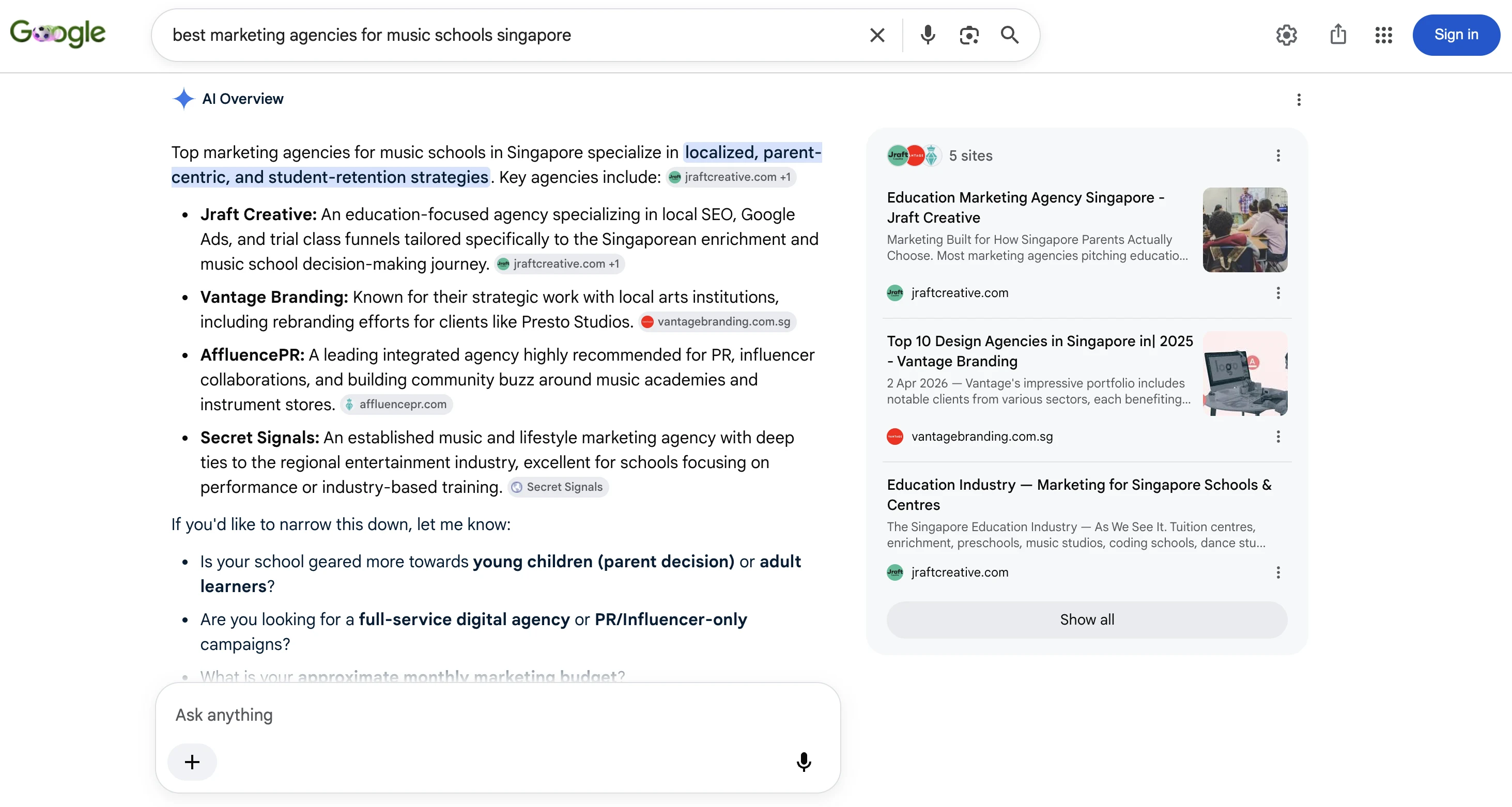
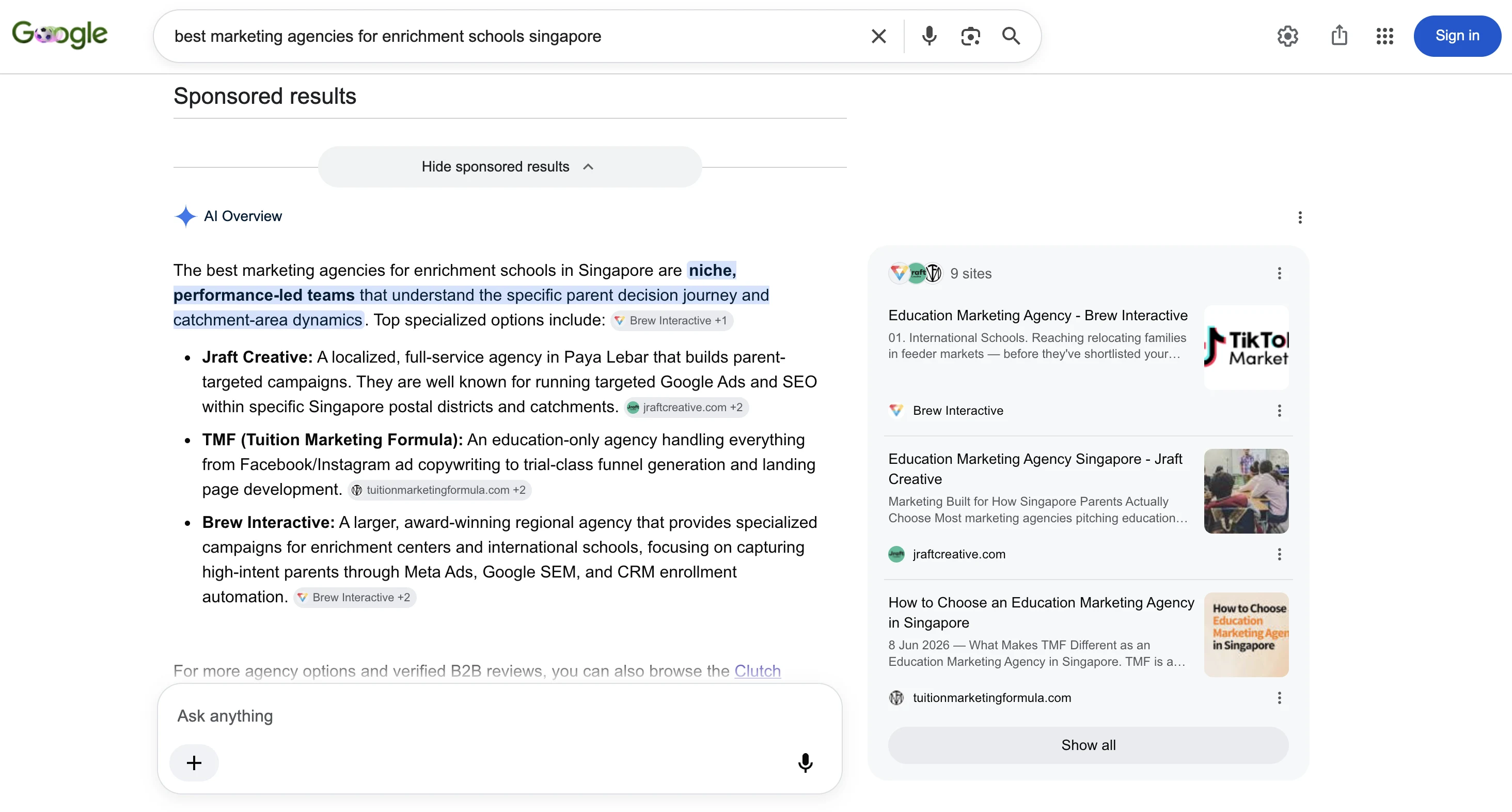
These are Google’s AI Overview responses — the AI-generated answers that now appear at the top of Google search results — for two niche Singapore queries:
- “best marketing agencies for music schools Singapore”
- “best marketing agencies for enrichment schools Singapore”
Both responses name Jraft Creative directly, with context, as one of the agencies worth recommending. No paid placement. No sponsored badge. Google’s AI engine decided, on its own, that we were a reasonable answer to a real buyer’s real question.
This wasn’t accidental. And it wasn’t fast. Here’s what we actually did to get there — what worked, where most agencies fall short, and what we’d tell a Singapore business owner who wants to do the same.
Why this matters now
In 2026, the way Singapore buyers research B2B services has shifted in a way most agencies still underestimate. When a Singapore school owner needs help with marketing, they’re as likely to type their question into ChatGPT, Gemini, or Google’s AI Overview as they are to scroll Google’s traditional blue-link results. The conversation has moved upstream.
What that shift means commercially is simple. The agencies, clinics, restaurants, schools and professional services cited in those AI responses get the first read. They’re the names buyers walk away with after their first search. They’re the names that get DM’d, emailed or called first — often before any traditional Google result is even clicked.
The overlap between Google’s top-10 traditional results and the brands cited in Google’s AI Overview is, according to multiple independent studies, below 30%. Ranking well on classic Google search no longer guarantees you’ll appear when Google’s AI generates an answer. The two systems evaluate different signals.
For Singapore businesses watching their organic traffic shift from blue links to AI Overview, the question has changed. It isn’t “are we ranking well?” anymore. It’s “is the AI naming us?”
The four categories of work we actually did
Most agencies who claim AI visibility expertise focus on one or two of these. To be cited consistently across niche queries, you need all four working in coordination.
1. Schema markup at scale
AI engines don’t read your website the way a human does. They parse structured data — the machine-readable layer underneath your content — to understand who you are, what you do, and what you can be trusted to say. Most Singapore service businesses have either no schema, or the bare-minimum schema their CMS auto-generates.
We rebuilt schema markup across every service and industry page on our site. Every page now carries structured data that explicitly tells AI engines what we offer, who we serve, and how our service differs from alternatives. The implementation is technical but the principle is simple: AI engines reward clarity. They penalise ambiguity. Most agencies stop at the bare minimum, and the gap between bare-minimum schema and AI-friendly schema is where the citations live.
If you want the technical foundation here, our Schema Markup for AI Overviews guide walks through the underlying principles.
2. Content depth, not content volume
AI assistants don’t cite pages that gesture at a subject. They cite pages that demonstrably know the subject well — pages with specifics, context, and substantive answers to the exact questions the AI is processing.
For us, this meant rewriting the marketing-services pages that target Singapore education clients to go deep. Not 500-word page-filler. Long-form, situationally-aware content that answers what Singapore school owners actually type — context (PSLE timing, MOE syllabus, parent decision frameworks), price transparency, real catchment dynamics, and the operational realities of running marketing for a small Singapore education business.
Generic copy that says “we help businesses grow” doesn’t get cited. Content that says “here’s how the parent decision journey works for Singapore enrichment schools, and here’s where most agencies fail to show up” does.
3. Citation footprint across third-party sources
This is the category most agencies underestimate. Google’s AI doesn’t just read your own website. It triangulates across third-party mentions — directory listings, press coverage, industry forums, review platforms — to verify whether what you say about yourself is also what others say about you.
We invested in earning third-party citations across the sources Google’s AI weights most heavily. Some of this is directory work. Some is press. Some is community presence. We won’t list our specific sources here — that’s part of the work we deliver to clients — but the principle holds: AI citations don’t come from a clean website alone. They come from a clean website and a verified footprint across the wider web.
If you’ve built a strong website but have weak third-party presence, the AI quietly downgrades you. If you have strong third-party presence but a thin website, the AI never finds enough to cite. Both matter. Most agencies get one and skip the other.
4. Topical authority through dedicated pages
AI engines reward demonstrated specialism. Generalist agencies who claim “we do everything” tend not to get cited. Specialist agencies — or generalist agencies with clearly demonstrated specialism in defined verticals — get the citation.
We built dedicated marketing pages for each industry we serve in Singapore: music schools, enrichment centres, tuition centres, clinics, dental, F&B, property, professional services and others. Each page demonstrates that we understand the vertical, not just the marketing channel. The pages connect through to our broader GEO agency Singapore service hub.
The result: when Google’s AI parses “best marketing agencies for music schools Singapore,” our music-schools depth gets surfaced. When it parses “best marketing agencies for enrichment schools Singapore,” our enrichment-schools depth gets surfaced. Same engine. Different signals. Same outcome — a citation Google decided we deserved.
What this actually took
Six months of consistent work. Multiple specialists working in coordination across schema implementation, content strategy, citation outreach, technical SEO, and ongoing maintenance. This wasn’t a weekend project. It wasn’t a “fix three things and watch the magic happen” exercise.
It’s also not finished. AI engines update their evaluation models continuously. The signals that earned citation today may shift in three months. What we built isn’t a one-time fix — it’s an operating discipline we maintain weekly across all four categories.
For a Singapore agency or business owner thinking of trying this themselves, the honest framing is: budget at least four to six months of focused work, expect to need technical, content, and outreach capacity simultaneously, and plan for ongoing maintenance once you’re cited. Anyone telling you it’s faster, easier, or fully automatable is selling you a tool, not the actual work.
Where DIY hits the wall
We’re not against DIY. Most Singapore SMBs have run their own SEO at some point and many have done so well. But three specific places consistently break down on AI visibility work:
Schema at scale. Adding schema to a single page is doable with a tutorial. Implementing structured data across 100+ pages, with the right schemas per page type, validated for AI engine consumption, isn’t a CMS plugin’s job. It’s a coordinated technical build.
Citation outreach. Earning mentions on the third-party sources that actually count is relationship work, not just outreach work. Knowing which sources matter for Singapore-specific AI citations versus generic global directories is the part that takes years of testing to learn. Most business owners don’t have either the relationships or the time.
Ongoing maintenance. AI engines reward freshness. A site that demonstrates currentness — recent content, current case studies, current schema reflecting current services — earns trust over time. Set-and-forget websites lose citation positions slowly but inevitably. The agencies and businesses cited consistently are the ones who maintain the discipline weekly.
If you have all three capacities running in-house, you can absolutely DIY this. Most Singapore SMBs don’t.
The 30-second test you can run today
Before you hire any agency, before you read another blog post on AI search, before you decide on anything — run this test on yourself.
- Open Google in an incognito window
- Type the query your customers would type when they’re looking for what you offer. Be specific. “Best [your service] in [your area]” is the format that matters.
- Look at the AI Overview that appears at the top of the page
- Are you in it? Are you named? With context?
If you’re not in it, who is? Click through to the brands that ARE cited. Are they direct competitors? Out-of-market alternatives? Tangential players?
That’s the position you should have. Right now, someone else has it.
The good news: AI Overview citations aren’t won or lost in a single shot. They shift as what’s on the web changes. If you’re not there today, you can be there in six months — with the right work, applied consistently.
The bad news: the work is real. And the agencies already cited have a head start that compounds.
If you’d rather not figure this out alone
If your test surfaced a gap — and you’d rather not spend six months mapping the playbook yourself — we built our AI Visibility Audit as the productised version of exactly this work.
It’s a five-to-seven-day, SGD 1,000 one-time engagement. We audit your current AI visibility across ChatGPT, Gemini, Perplexity, and Google’s AI Overview, identify the specific gaps for your business, and deliver a prioritised roadmap to close them. If you continue with us on the implementation side within 30 days, the SGD 1,000 credits to your first month of GEO agency work.
The audit is paid upfront because the audit IS the work — there’s no abbreviated version that costs less but delivers less. What you get is the same diagnostic we’d build for ourselves.
Start with the AI Visibility Audit →
Or, if you want to understand the broader picture first, our GEO agency Singapore service overview walks through the full scope of what AI visibility work looks like end-to-end.